
How does a recycling baler work?
A hydraulic system drives a press plate against material inside a chamber. Repeated loading and compression form a bale. The finished bale is secured and removed using the machine's designated tying and unloading system.
This is a description of the process, rather than an operating sequence. Loading limits, controls, tying arrangements and bale removal differ between machines. Operators need training and the instructions for the exact model they use.
A baler does not recycle material on its own. It prepares an accepted material stream for onward handling. Arrangements with your recycling collector remain part of the process, including the type and condition of material and the bale format they accept.
Vertical and horizontal balers: what is the difference?
A vertical baler compresses downwards. It is often considered where floor space is restricted or packaging waste is handled in batches. The whole working area still matters: operators need access for loading, unloading and servicing.
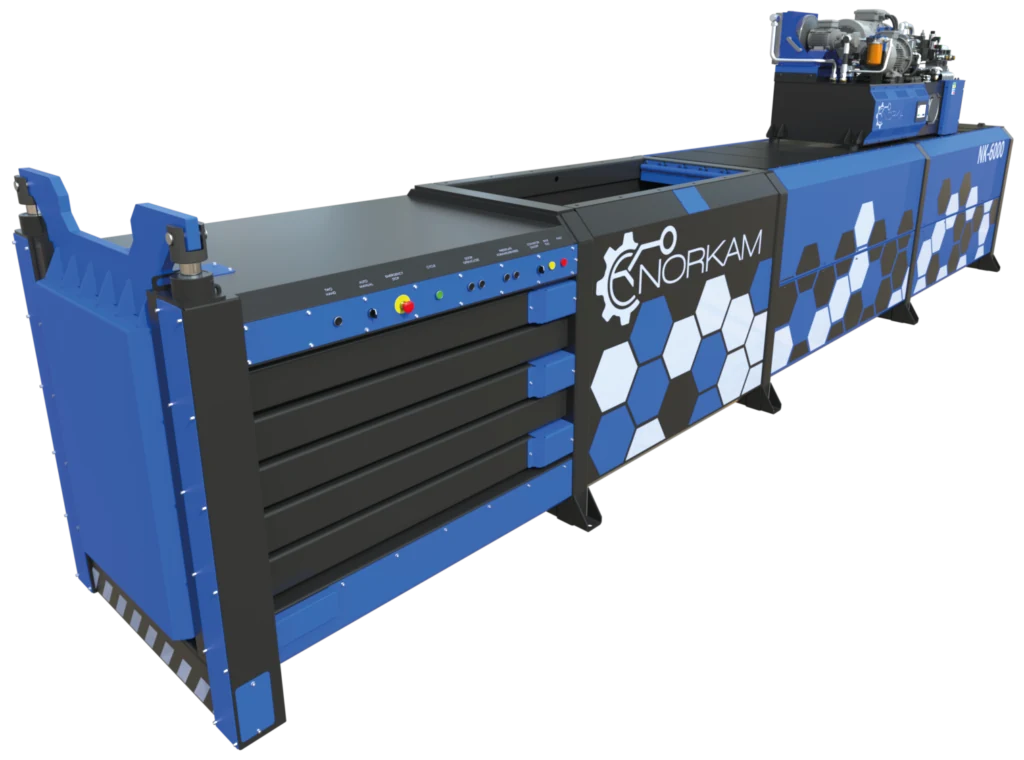
A horizontal baler compresses along the length of the machine. Its loading arrangement and bale discharge area are central to the installation. This layout can suit businesses with larger, more sustained flows of suitable recyclable material.
The category alone does not tell you the machine's capacity. NORKAM's vertical range includes the compact NK-60 and the larger NK-500. The semi-automatic horizontal range includes the NK-6000L, NK-6000 and NK-7000. Compare the actual specification and handling process.
What materials can a recycling baler handle?
NORKAM lists cardboard, paper and plastic film for its vertical range. The horizontal range also lists PET bottles and drinks cans. Confirm suitability for your particular material, including its size, preparation and condition, before selecting a machine.
Keep material streams separated to meet the requirements agreed with your collector. Mixed or contaminated material can change whether a bale is accepted. A machine described as a cardboard baler should not be assumed to process every other type of business waste.
Why do businesses use balers?
Loose packaging takes up storage space. Compressing it into a defined form can make that space easier to organise and help consolidate collections. The useful benefit depends on the material, available area and the route from waste generation to collection.
Less volume does not automatically mean a lower bill. Collection contracts, staff time, consumables, electricity and the cost of owning or renting the machine all affect the result. Any payment for recyclable material must also be agreed with a collector.
What should you check before choosing a baler?
Start with representative waste quantities over a defined period, including peaks. Record the material types and the size of items that need loading. Photographs of the waste and a simple site plan help explain the job.
Check the available electrical supply, installation access and space for loading, maintenance and finished bales. Discuss the handling equipment you use and the dimensions and weights your collector accepts.
Share these details with NORKAM to shortlist suitable machines. Pressing force and published bale weight are useful specifications, but neither describes the entire working process.
Common questions
Is a cardboard baler the same as a recycling baler?
A cardboard baler is a recycling baler selected for cardboard. Some models also handle other specified materials, but suitability should be confirmed for each waste stream.
Does a baler shred waste?
Baling and shredding are different processes. A baler compresses material into a bale; a shredder cuts material into smaller pieces. Do not assume a baler provides shredding or document destruction.